Friday, September 13, 2013

Canteen

Our instructor makes sure that we get to go to the school canteen at least once during our class.  Sometimes we get tea and a snack and other times we will eat an entire meal.  Melissa and I love going to the canteen!  It is very cheap to eat there and everything is homemade by babushkas in the kitchen.  We talk to the same babushka everyday and she wants to make sure that we try all kinds of Russian dishes.  She even checks our trays after we eat to see what we liked/disliked!  


We were able to eat in the "teachers" dining room during our breaks.  You can see in the photo below that it was pretty fancy!  


Black.

The next step in our process was to finalize details and to add black.  Black could be added to the colors or to cover up mistakes.  I ended up covering up a lot of mistakes!  It is so hard to control the brush within such a small space.  Melissa and I were happy to learn that this was an acceptable part of the technique.  It made us a little less nervous when we were painting.  We ended up using the black paint as an eraser.  

 As I have mentioned in a previous post, the brushes that we are using are made out of squirrel hair.  We were lucky enough to use one of our instructor's handmade brushes today.  I think she was holding out on us until we got better at the process!!  This brush was very nice and painted an even, thin line.  You can see a couple photos of the brush here:


In many of the photos, you can see that we are leaning our wrists on a brace.  This is important because it allows you to paint in a more controlled manner. We were happy to have it and have learned to paint using the brace.  At first, I found myself moving my entire arm around so that I would not have to use it but the instructor put a stop to that habit!

We have found that we have to get up every hour or so and walk around.  Melissa enjoys looking at the artwork around our classroom.  Here, you can see her in front of the iconostasis.  We never tire of studying all of the details!  We also have a couple of different work stations.  We usually spend most of our time painting, however, when we have down time, we end up studying or practicing drawing and patterning.  You can see some of the photos of our different work stations below.  


I have been so impressed with the quality of the school.  They make sure to give us tours and show us around and the quality of the student work is amazing.  I am even impressed with the chairs that we get to sit in!


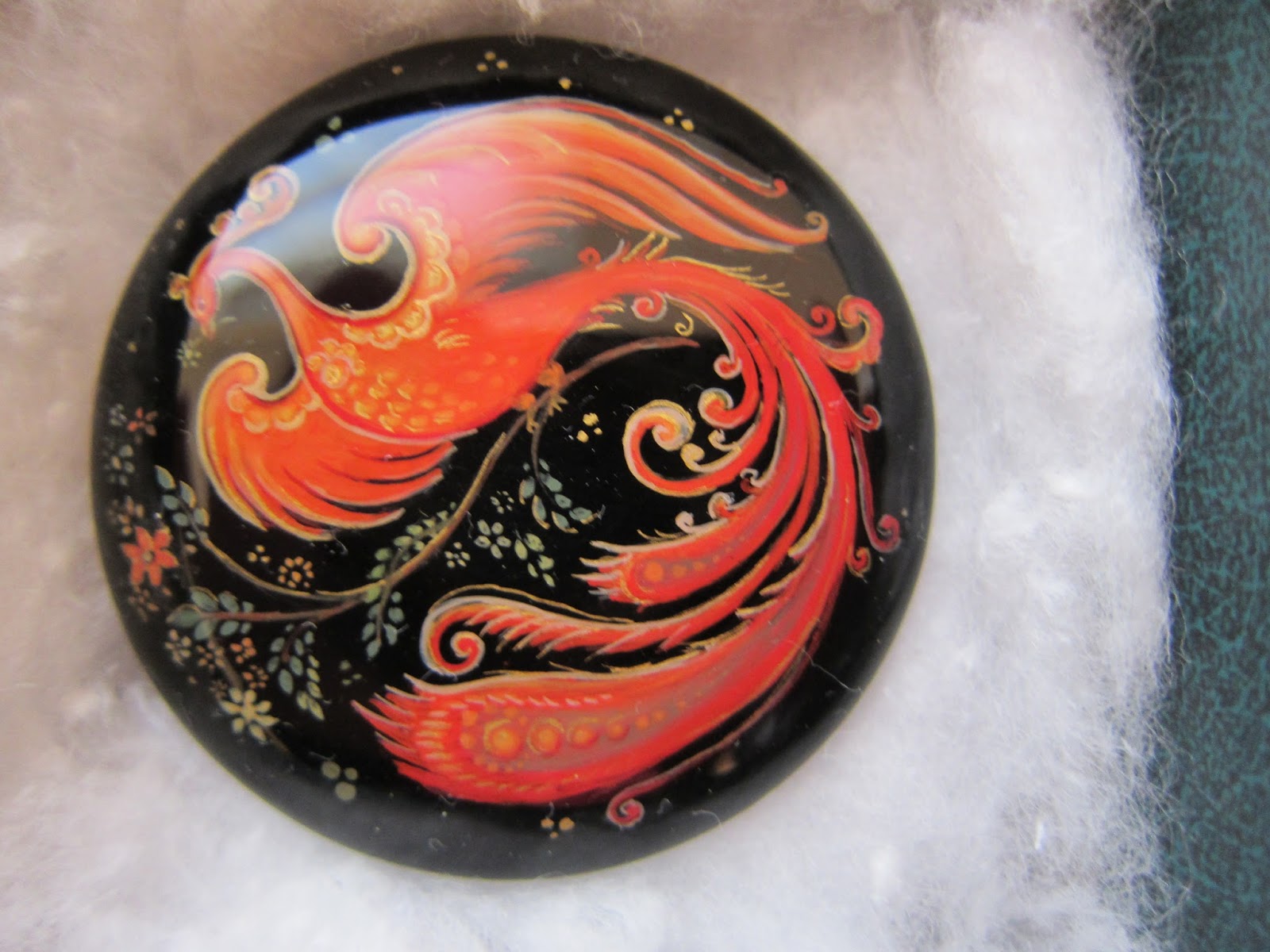
The final step that we completed was to put a thin layer of lacquer over our painting.  This step made us both very nervous but it really helped bring the colors to life!  During the entire process, we have to take care not to get any dust or small hairs on our painting.  We are constantly brushing a feather over our brooch to remove any possible dust.  This was exceptionally important before we applied the lacquer.  Next step.........GOLD!!!!

Monday, September 9, 2013

Our goal today was to depict the reflection of light and the presence of shadow within our painting.  For example, if the light was cast upon the head and breast of the bird, the tail would be darker.  Our teacher placed a lot of importance on creating a balanced piece of artwork.  The Palekh tradition calls for harmony and balance within each composition.  This step helped our painting come to life.  During this process, we needed to mix a larger amount of emulsion into our pigment to create a more transparent paint.  This transparent paint was then applied to the "white color" to create our shadows and highlights.


 We really enjoyed bringing our images to life!  It is a slow process, however, each day we feel that we are making a lot of progress.

St. Isaac's Cathedral

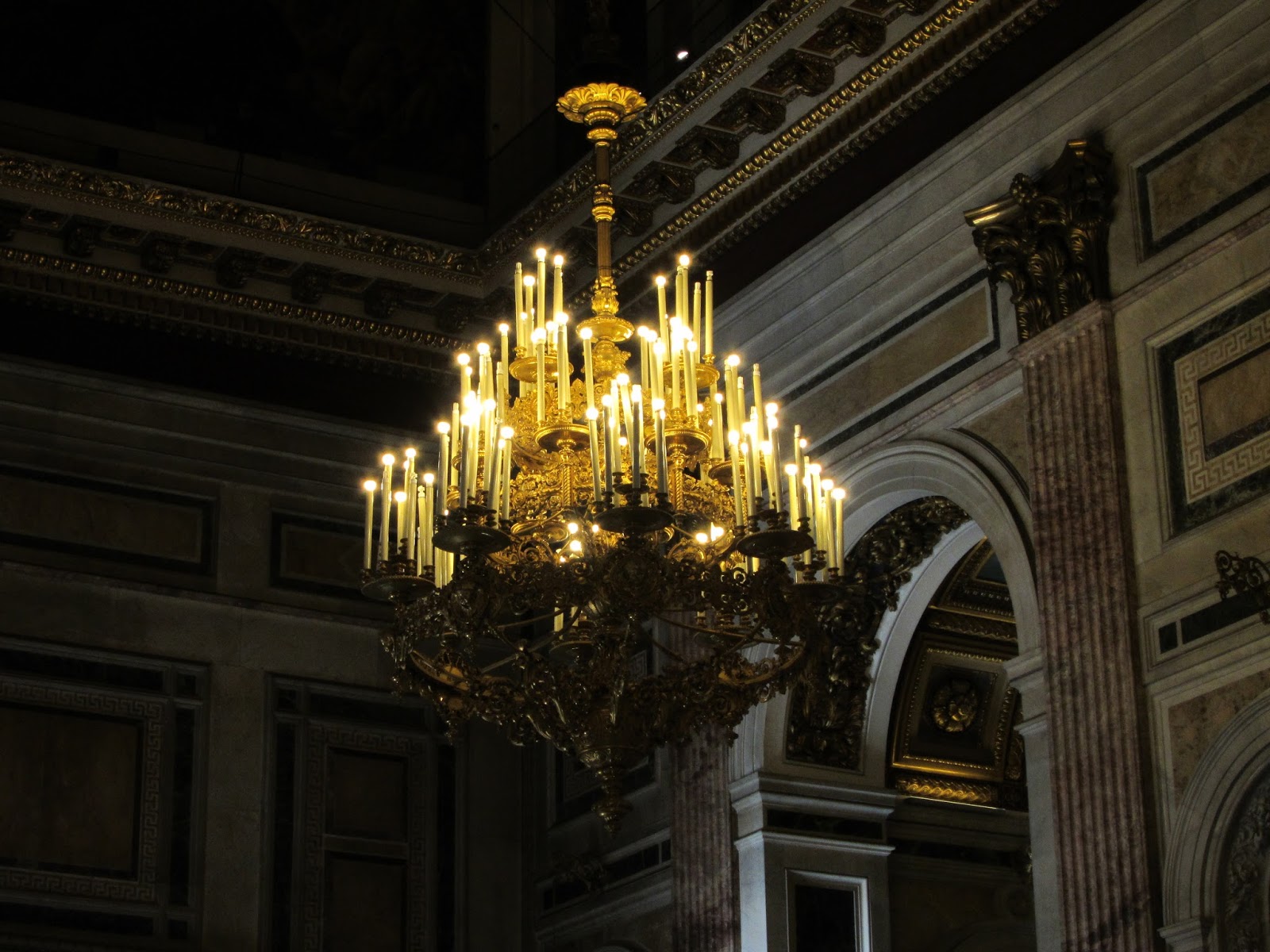
Our teacher told us that we should visit this cathedral in St. Petersburg.  We went on a tour and were able to see some beautiful artwork.  St. Isaac's cathedral has a long and interesting history.  It was built between the years of 1818 and 1858 and is quite impressive.  The dome is gilded with pure gold and the main structure is almost entirely built out of granite and marble. 

The columns shown on the pictures below are made out of single pieces of red granite.  There was a model, which you can see below, that showed how the Russians raised each and every column.   If you look closely, you can see that one of the columns shows damage from WWII.  They actually painted the gold dome grey during the war to avoid attracting attention from the enemy aircraft!


The interior of the cathedral is covered with various artwork.  Even the cathedral's doors are covered in relief sculptures and are very detailed.  


The iconostasis is quite majestic and is framed by eight columns of semiprecious stone.  Our teacher is also a master in icon painting and she really wanted us to see this masterpiece.  Most of the paintings in the cathedral were completed by Russian artists, however, when some of them started to deteriorate due to the cold conditions, the architect had some of them reproduced as mosaics.  We were amazed at the amount of detail that the artists were able to achieve with tiny stones!!


Friday, September 6, 2013

Squirrels?


The traditional brushes that are used for Palekh painting are made from the hair of the Siberian squirrel.  Specifically, hair from the squirrel's tail.  Our teacher told us how she used to make her own brushes using shells from ammunition and feathers.  It was very unbelievable!  She was traveling in Belgium and all of her brushes were stolen.  So sad!!!  She had to buy new brushes.  We are starting to get the hang of using such small brushes.  We have to put very little pressure when painting, to get a nice thin line and to have better control.  I always have a hard time at the end of the day.  My hand starts to shake and I lose control of my line.  However, our instructor said that this will get better with practice.  I will have to start working on training my muscles!


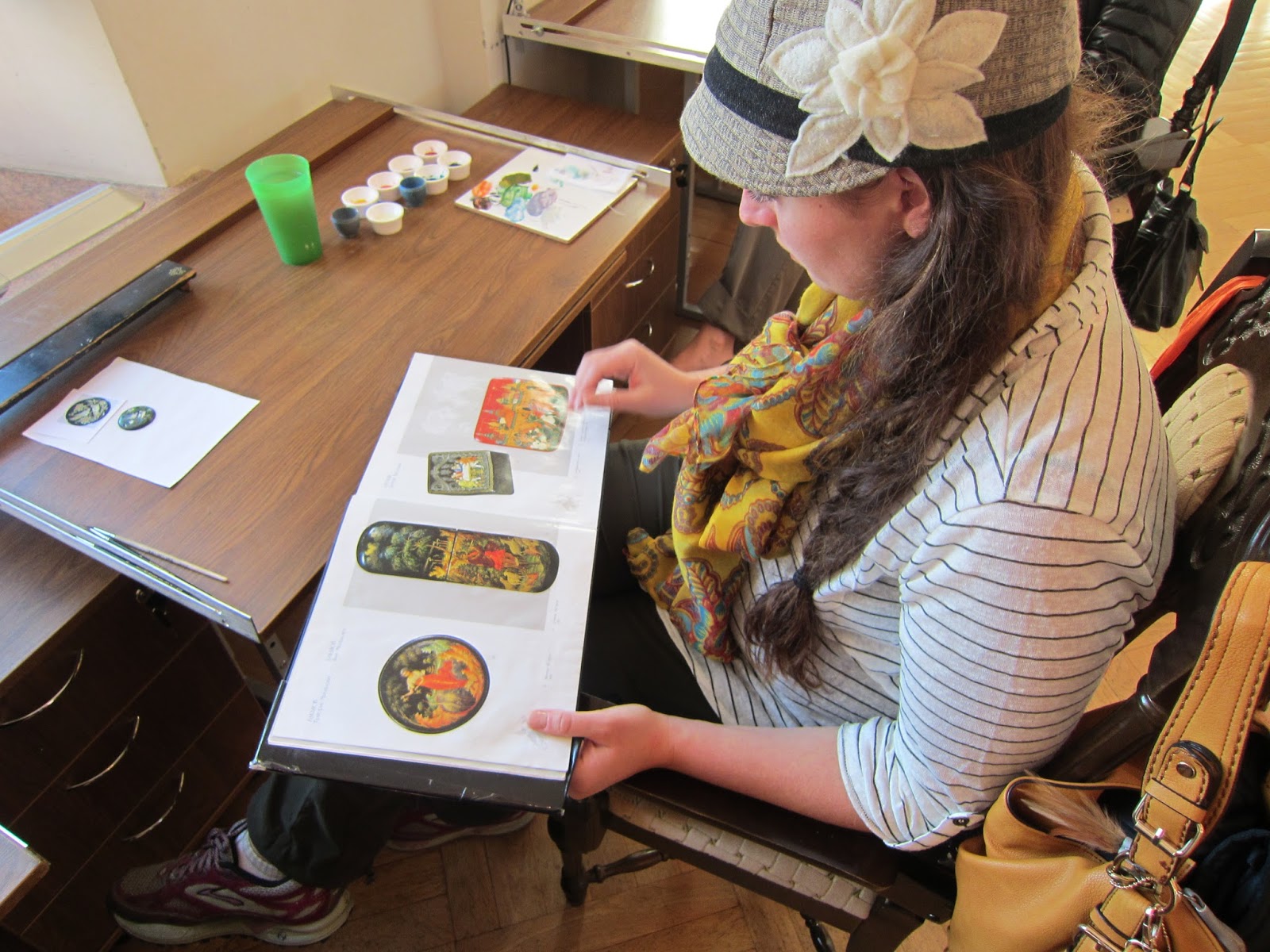
Our instructor showed us some different examples of paintings based on the theme of "Firebird".  It was interesting to see what each artist did with the theme and how much detail they were able to fit into such a small space.  She also let us know that Palekh paintings should always be stored in a box with cotton to protect the lacquer.  


Color!


Our first 2-3 days of class were spent preparing our paint and painting surface as well as learning about the history of Palekh painting.  Today we were able to start with color!  After our white paint was completely dry, we were able to start mixing color into white paint to add some tones to the painting.  We are learning that all of the steps take quite a long time, but each step is very important.  


Melissa and I have begun to immerse ourselves in the process.  We enjoy the hours of concentration that are involved and the intense amount of focus that is needed.  Our teacher keeps us busy studying the different styles of Russian Miniature painting when we are not actually painting.  She always knows the right time to give us a break and we all head down to the school's canteen for tea and snacks.  


You can see in the photo below that we are slowly building up the color.  Our next step will be shading!